How to become the obvious choice in a crowded market
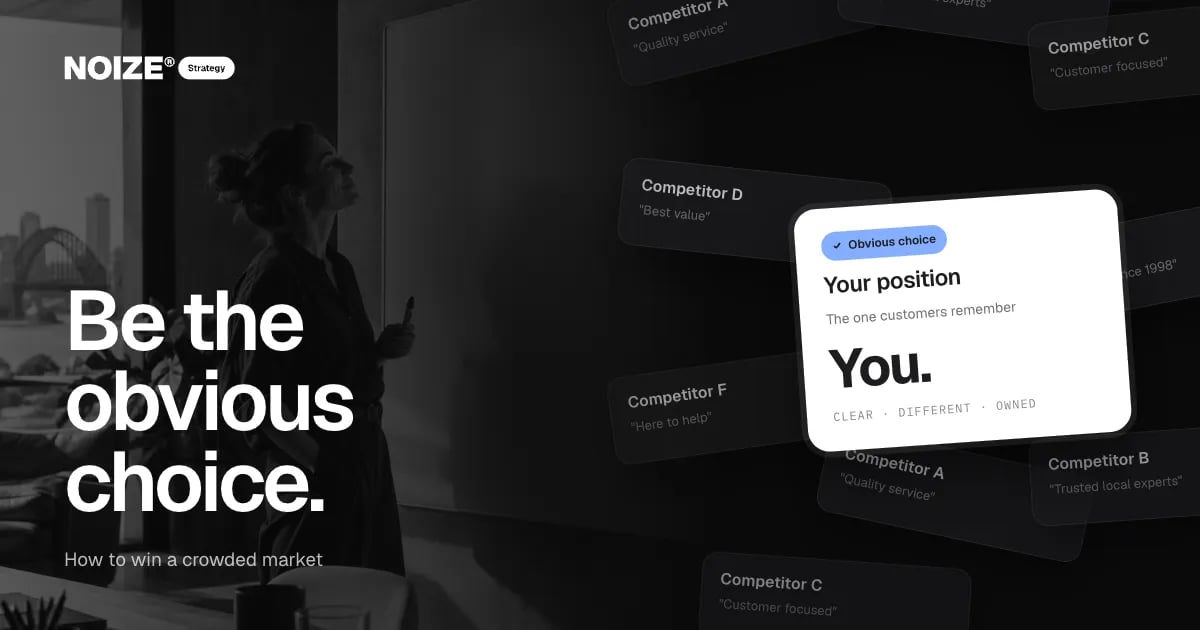
Customers mix you up with competitors. Your website says "quality service". So does theirs. Your tagline mentions trust, experience and value. So does everyone else's. When a customer compares three businesses that describe themselves the same way, they do the obvious thing and choose on price.
Becoming the obvious choice isn't about shouting louder. It is about standing somewhere different, and saying so clearly. That is what positioning does.
The short version
- Positioning decides who you are for, what you do better than anyone else for them, and why it matters.
- Find it by talking to your best customers, mapping what competitors actually claim and being honest about your strengths.
- Then say it in one sentence and use it everywhere.
- A clear position lets you charge properly, attract better-fit customers and make every other marketing decision easier.
Why crowded markets look the same
In most industries, businesses copy each other. Someone writes "trusted local experts" on their website, it seems to work, and within a year half the market says it. Over time the language converges until customers can't tell the difference.
The same happens with visuals, offers and pricing. The result is a category of interchangeable businesses, each hoping to win on service once the customer finally calls. Most customers never call. They pick whoever looks safest or cheapest from the search results.
What positioning actually is
Positioning is a choice. It answers three questions in plain English. Who is this business for? What does it do differently or better for those people? Why should they care?
A good position is specific. "Accounting for small business" is a category. "Accounting for hospitality groups with more than one venue" is a position. The second excludes most people, and that is exactly why it works. The right customers recognise themselves immediately.
How to find your position
01Start with your best customers
Look at the customers who are most profitable, easiest to serve and most likely to refer you. What do they have in common? Why did they choose you? Ask them directly. Their words are often better than anything a marketing team would write.
02Map what competitors really claim
Collect the headlines, taglines and offers of your five closest competitors. Lay them side by side. You will see the crowded ground immediately: the words everyone uses and the promises everyone makes. Your position should sit somewhere else.
03Be honest about your strengths
What do you do that competitors don't, or do much better? It might be speed, specialisation, a method, a promise, a type of customer you understand deeply, or the experience of the people involved. It has to be true and it has to matter to the customer.
04Find the gap that matters
The best position sits where three things overlap: something your best customers value, something you are genuinely good at and something competitors aren't claiming. That overlap is rarely obvious from the inside, which is why an outside view helps.
> I've worked with multibillion-dollar clients and first-year founders, and positioning is the one conversation that changes both. The moment a business can say in one sentence why it wins, everything gets shorter: the website, the pitch, the sales cycle.
05Write it in one sentence
If it takes a paragraph, it isn't finished. A positioning statement should be short enough that every person in the business can repeat it. It isn't necessarily customer-facing copy, but it guides all of it.
06Use it everywhere
A position only works if it is used consistently. It shapes the brand, the website headline, the ads, the proposals and how the team answers the phone. Every touchpoint should reinforce the same idea.
“Seriously, the best branding agency in the country.”
What a clear position changes
- Pricing. A business that is clearly the best choice for a specific customer can charge more than one competing on general quality.
- Marketing efficiency. Ads, content and search work harder when they speak to a defined audience with a distinct message.
- Sales. Prospects arrive already understanding why you're different, so conversations start further along.
- Focus. It becomes easier to say no to work that doesn't fit, which protects margin and the team's time.
Positioning and the rest of the business
Positioning is part of NOIZE Strategy, alongside market analysis and customer strategy. Once it is set, NOIZE Creative turns it into a brand: a name, an identity and a voice that make the position visible. Marketing takes it to the right audience. Sales uses it to qualify and close.
That is why it pays to set the position before the brand and before the campaign. Everything downstream is built on it. See strategy.noize.com.au and creative.noize.com.au.
A quick positioning test
Take your website headline and cover your logo. Then read your three closest competitors' headlines the same way. If you can't tell which business is which, the market can't either.
Now try writing one sentence that finishes "We are the only business that..." without using the words quality, service, trusted, experienced or value. It is harder than it sounds, and the attempt usually surfaces the real difference. If you can't finish the sentence honestly, that is the clearest sign positioning should come before any new brand or campaign work.
When businesses get this right, the effect is visible quickly. Enquiries arrive from better-fit customers, sales conversations start further along and pricing conversations get easier, because the customer already understands why you are different and why that matters to them. The same marketing budget produces more, because it is finally saying something nobody else is.
Questions to ask before you start
Ask whether your best customers could describe why they chose you. Ask which competitor you lose to most, and why. Ask what you would never compromise on. Ask which customers you would happily lose. Ask what a customer would miss if you disappeared tomorrow. The answers are the raw material of a position.
Related reading
- Why busy businesses stall, and what to decide before you spend another dollar
- What a growth roadmap gives you, and the decisions it saves you from making twice
Common questions
What is brand positioning?
The deliberate choice of who your business is for, what it does better for them, and why it matters, expressed clearly enough to guide every marketing and sales decision.
How do I know if my positioning is weak?
If customers compare you mainly on price, confuse you with competitors, or your website could belong to any business in your industry, the positioning needs work.
Will a narrow position limit my business?
Usually the opposite. A clear position attracts more of the right customers and lets you charge properly. You can still serve others; you just stop chasing them.
How is positioning different from a tagline?
The position is the strategic choice. A tagline is one short expression of it for customers. The position comes first.
Can positioning change over time?
Yes. It should be reviewed when the market, the offer or the business changes significantly, but it shouldn't change often.
Who should be involved in setting positioning?
The owner or leadership team, someone who speaks to customers every day, and ideally an outside view to challenge assumptions. Customer interviews are one of the most valuable inputs.
Your first strategy conversation is on us.
Have a chatThe brand for business.