Getting the plan out of one person's head
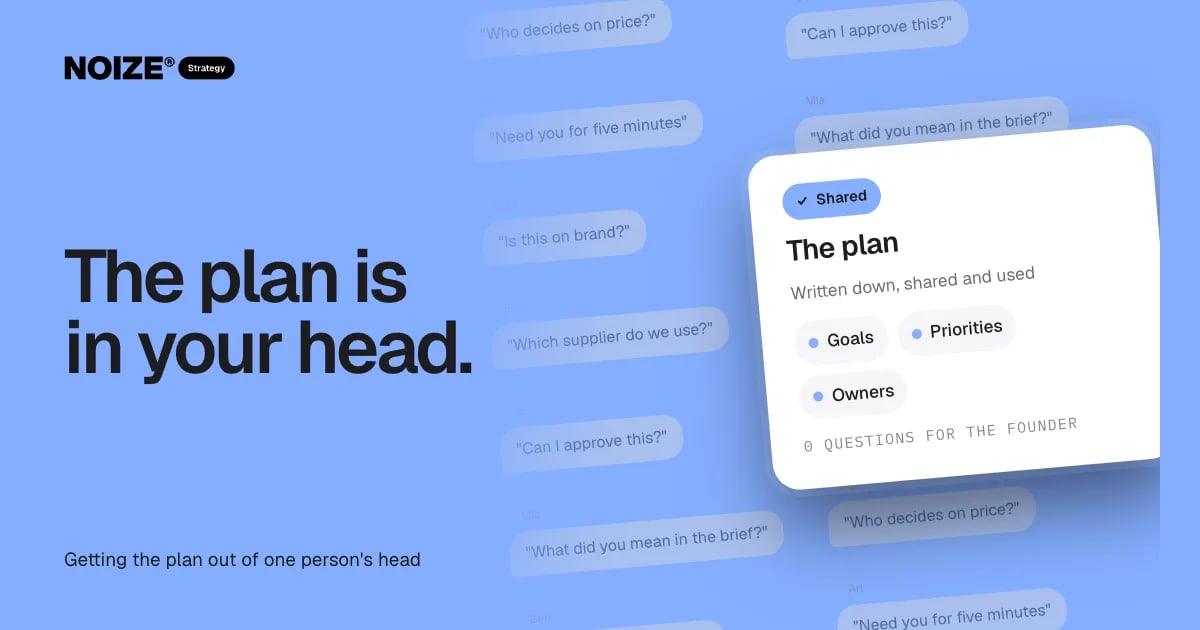
- "Which supplier do we use?
- " "Can I approve this?
- " "What did you mean in the brief?
- " "Who decides on price?
- " "Have you got five minutes?
"
If your day is a stream of questions like these, the plan lives in your head. That works when the business is small. As it grows, it becomes the main thing holding it back. Every decision routes through one person, and that person's calendar becomes the ceiling on growth.
The short version
- When the strategy exists only in the founder's head, the team can't act without asking, decisions slow down, and the founder becomes the bottleneck.
- Writing the plan down, with goals, priorities, decision rules and owners, lets the team act with confidence.
- It frees the founder's time, makes growth possible past one person, and makes the business more valuable if it is ever sold.
How the plan ends up in one head
It usually happens naturally. In the early years the founder makes every decision because there is nobody else to make them. The direction, the standards and the priorities are all obvious to them, so there is no reason to write them down.
As the team grows, the founder still holds the picture. New people pick up pieces of it by asking. Over time, the business develops a habit: when in doubt, ask the founder. Nobody designed it. It just became how things work.
What it costs
- Speed. Decisions wait for the founder's availability. A quote that could go out at ten waits until after five.
- Quality. Without written priorities, people guess. Some guess well, some don't, and the founder spends time correcting work that went the wrong way.
- The founder's time. Hours each week go to answering questions that a written plan would answer once.
- Growth. The business can only grow as fast as one person can make decisions.
- Value. A business that depends on its founder is worth less to a buyer or investor, because the value walks out the door when the founder does.
> I've built and sold businesses, and the hardest conversations in due diligence were always about founder dependency. Buyers want to know the business works when you're on holiday. The best answer is a plan the team already uses without you.
What to write down
01Where the business is going
The goals for the next one to three years, stated specifically enough that everyone would recognise success. One page is enough.
02Who the business is for
The best-fit customer and the position: why those customers should choose you. This guides marketing, sales and service decisions every day.
03What matters most right now
The current priorities, in order. When two things compete, the team should be able to see which wins without asking.
04How decisions get made
Decision rules for the common questions: who can approve spend up to what amount, how prices are set, which suppliers to use, what "on brand" means. Each rule removes a category of questions.
05Who owns what
Every area of the business and every roadmap step has an owner. Ownership includes the authority to decide within the rules.
06How progress is measured
A few numbers reviewed regularly, so the team can see whether the plan is working without waiting for the founder's view.
“A brand for us to stand behind and be proud of.”
Making it stick
Writing it down is half the job. The other half is using it. Refer to the plan in meetings. When someone asks a question the plan answers, point them to it rather than answering directly. Review it quarterly with the team so it stays current and owned by more than one person.
The first month feels slower. After that, the questions drop sharply, and the founder's week starts to change.
Where Strategy fits
NOIZE Strategy helps founders and leadership teams get the plan out of one head and onto paper, using the Infin8 System to cover the whole business. The result is a plain-English roadmap with priorities, owners and measures that the team can act on.
When the plan needs people to deliver it, NOIZE Talent can bring in fractional leaders or specialists. When it needs a brand that reflects the direction, Creative builds it. See strategy.noize.com.au.
Signs the plan is stuck in your head
Your phone is the busiest in the business. Projects stall when you are away. New staff take months to become independent. Different people give customers different answers. You are the only person who can approve a quote, a hire or a supplier. You haven't taken a full week off in years, and you are not sure the business would cope if you did.
None of these mean the team isn't capable. They mean the team doesn't have what it needs to act without you. That is a gap in the plan, not in the people, and it is very fixable.
What it changes for the founder
Owners who get the plan out of their head describe the same shift. The questions slow. Decisions start happening without them, and mostly in the way they would have chosen. Their time moves from answering to leading: thinking about the next stage, the biggest customers, the next opportunity. For many, it is also the first time in years they can switch off properly.
Where to start this week
For one week, write down every question that comes to you. At the end of the week, group them. Most will fall into five or six categories: pricing, approvals, suppliers, priorities, brand, customer issues. Each category is a decision rule waiting to be written. Write the first two rules and share them with the team. You will feel the difference within a fortnight.
Questions to ask before you start
Ask which decisions only you can make, and which you make out of habit. Ask what the team would do differently if they knew your priorities. Ask what would break if you were away for a month. Ask which questions you answer every week. Ask who could own each area if they had the rules. The answers show where to start writing.
Related reading
- What a growth roadmap gives you, and the decisions it saves you from making twice
- Why busy businesses stall, and what to decide before you spend another dollar
Common questions
What is founder dependency?
When a business relies on its founder for most decisions, relationships or knowledge, so it slows or stalls without them.
How do I get my team to make decisions without me?
Give them a written plan with clear priorities, decision rules and ownership, then consistently point them to it instead of answering directly.
Does writing a plan take a long time?
A useful plan is short. With help, most founders have a working version within weeks.
Will a written plan make the business less flexible?
No. It makes change easier, because everyone can see what is changing and why.
Does founder dependency affect the value of my business?
Usually, yes. Buyers and investors pay more for businesses that run well without the founder in every decision.
Where should I start?
Track the questions that come to you for a week, then write decision rules for the most common categories.
Your first strategy conversation is on us.
Have a chatThe brand for business.